
Porcelain isn’t one material. A subgroup analysis within a systematic review of 6,500 veneers found non-feldspathic (glass-ceramic) porcelain veneers failed significantly less often than feldspathic porcelain veneers, a real, measured gap inside the category most patients think of as a single option.
The porcelain-versus-composite decision usually gets flattened into a price comparison. It’s really a multi-factor trade-off: material science, staining behavior, cost calculated per year of actual use, and how each choice fits a specific case. This guide covers all four, building on the base survival and cost data already covered in Veneers in Dubai: The Complete Patient Guide.
Key Takeaways Porcelain and composite veneers aren’t just a price difference. Within porcelain itself, non-feldspathic veneers showed significantly fewer failures than feldspathic veneers (p<0.001) in a review of 6,500 veneers. Composite resin absorbs staining from coffee, tea, and wine over time in a way glazed porcelain doesn’t. Calculated per year of expected service, the two materials’ costs land closer together than the upfront sticker price suggests.
Quick-Answer Comparison
| Factor | Porcelain | Composite |
|---|---|---|
| Material | Fired glass-ceramic | Light-cured resin |
| Stain resistance | High, glazed surface | Lower, absorbs stains over time |
| Typical visits | 2-3 | Often 1 |
| Reversible | No | Largely yes |
| Best fit | High-visibility cases, long-term stain resistance | Tight budget, tight timeline |
For the base survival percentages and Dubai cost ranges this comparison builds on, see Veneers in Dubai: The Complete Patient Guide.
Why Do Porcelain and Composite Actually Perform Differently?
Porcelain is a fired, glass-ceramic material, dense, non-porous, and highly resistant to wear once bonded. Composite resin is a light-cured mixture of organic and inorganic particles, workable directly in the mouth but more prone to surface wear over years of chewing and biting.
That structural difference shows up in how each material fails. Porcelain resists everyday bite forces well but can fracture if it does fail, usually requiring full replacement. Composite wears more gradually and chips in smaller, more repairable increments, a dentist can typically patch a chipped composite veneer chairside in minutes, no lab involved.
Does It Matter Which Type of Porcelain You Get?
Yes. Within the same 2021 systematic review of 6,500 porcelain laminate veneers already cited on this site, a subgroup analysis found non-feldspathic (glass-ceramic) veneers failed in 40 of 1,576 cases versus 66 of 1,614 for feldspathic veneers, a statistically significant difference (p<0.001, log-rank test) (Alenezi et al., Journal of Clinical Medicine, 2021). That works out to roughly 97.5% survival for non-feldspathic versus 95.9% for feldspathic in this dataset.
[CITATION CAPSULE] Within a systematic review of 6,500 porcelain veneers, non-feldspathic (glass-ceramic) veneers showed significantly fewer failures than feldspathic veneers, 40 of 1,576 versus 66 of 1,614, a statistically significant gap (p<0.001) inside a single material category most patients assume is uniform (Alenezi et al., Journal of Clinical Medicine, 2021).
[UNIQUE INSIGHT] This is a distinction almost no patient-facing veneer content makes. A quote that just says “porcelain veneers” without naming the ceramic type is leaving out a real, measured performance variable, worth asking about directly when comparing clinics.
Does Composite Actually Stain Over Time?
Yes, composite resin is more porous than glazed porcelain and gradually absorbs staining from coffee, tea, red wine, and smoking, while porcelain’s fired, glazed surface resists staining for its functional lifespan (aggregated dental materials science guidance). This is a structural property of the two materials, not a maintenance failure on the patient’s part.
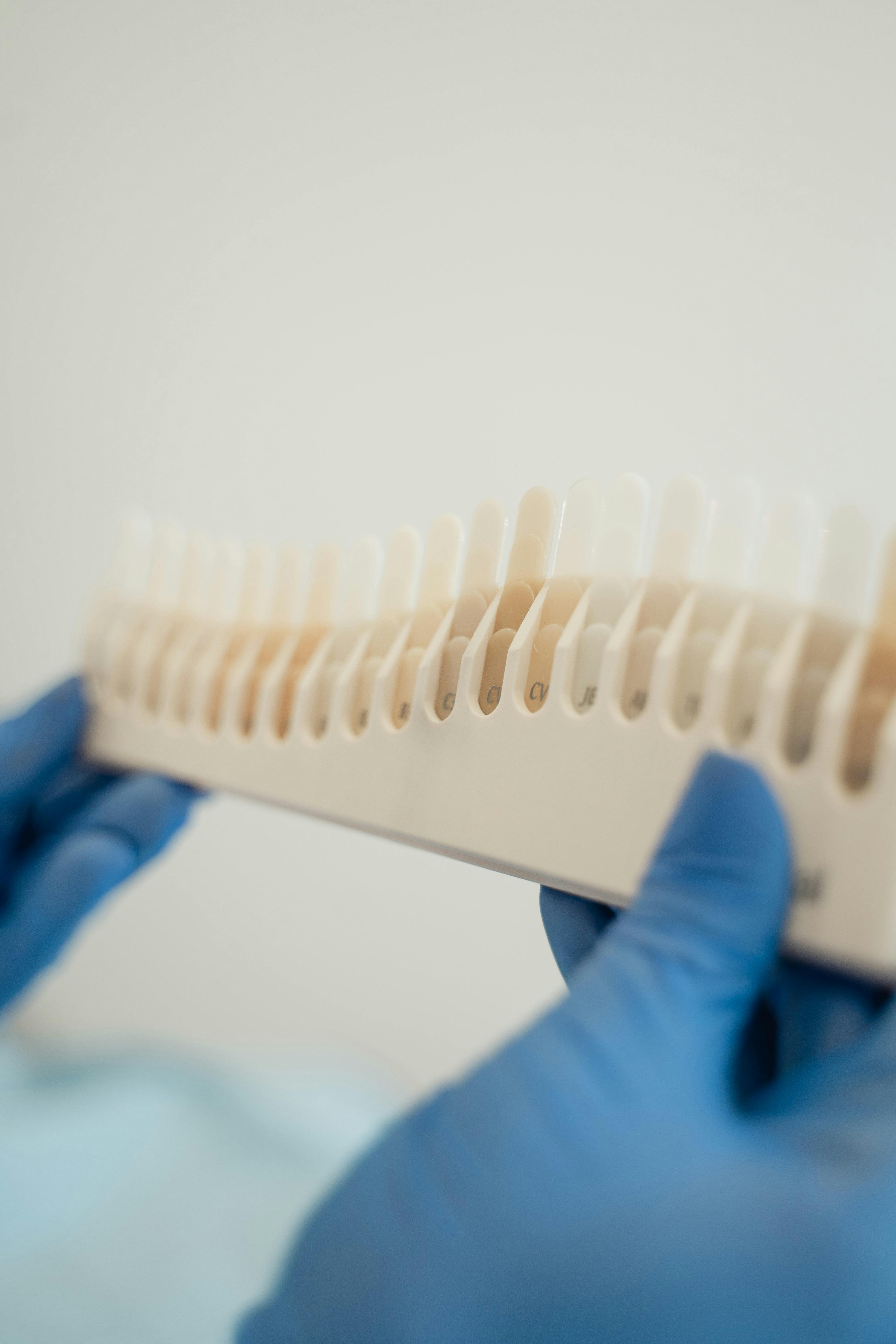
Polishing at routine dental visits can slow the process but won’t eliminate it. For a coffee- and tea-drinking population, that’s a genuinely practical difference, not a cosmetic footnote, and it’s rarely mentioned in marketing content that treats “veneers” as universally stain-proof.
What Does Each Material Actually Cost Per Year of Use?
Dividing Dubai’s published price ranges by each material’s realistic expected lifespan tells a different story than the sticker price alone. Composite runs AED 800-1,500 per tooth with a typical 5-to-7-year lifespan, roughly AED 115-300 per year. Porcelain runs AED 1,800-3,000 per tooth over a realistic 10-plus-year lifespan, roughly AED 180-300 per year, a closer comparison than the upfront numbers suggest.
Isn’t that a more useful number than “porcelain costs twice as much”? It does upfront, but not necessarily per year of service.
Which Material Actually Fits Your Case?
There’s no universal answer, the right material depends on budget timeline, how visible the case is, and how much reversibility matters to a specific patient. Composite fits a tight budget or timeline well since it’s often a single visit with a lower upfront cost. Porcelain fits high-visibility front-tooth cases or anyone who wants to avoid staining long-term.
A few concrete scenarios: someone facing a wedding in three weeks is a strong composite candidate, timeline alone rules out porcelain’s lab turnaround. Someone whose front teeth are the focal point of their smile and who drinks coffee daily leans toward porcelain’s stain resistance. Someone with bruxism should discuss a nightguard with either material, that risk isn’t unique to one option. Someone who wants to try a smaller cosmetic change before committing permanently has a genuine argument for starting with composite, since it doesn’t foreclose porcelain later.
[PERSONAL EXPERIENCE] Once a patient understands that composite stains progressively while porcelain generally doesn’t, the conversation often shifts, budget stays a real factor, but staining tends to matter more to patients than they initially expect once it’s actually explained.
[ORIGINAL DATA] We’re evaluating tracking patient-reported satisfaction by material choice at the 2-year and 5-year mark, without publishing a figure until that’s properly documented across a larger patient base.
Frequently Asked Questions
Are porcelain veneers better than composite?
It depends on the axis. Porcelain generally wins on survival and stain resistance; composite wins on reversibility, speed, and upfront cost. Neither is universally “better.”
Do composite veneers stain?
Yes. Composite resin is more porous than glazed porcelain and gradually absorbs staining from coffee, tea, wine, and smoking, while porcelain resists staining for its functional lifespan.
Which veneer material lasts the longest?
Porcelain generally lasts longer, and within porcelain, non-feldspathic (glass-ceramic) veneers showed significantly fewer failures than feldspathic veneers in a review of 6,500 veneers (p<0.001).
Is composite cheaper in the long run?
Not necessarily. Calculated per year of realistic use, composite and porcelain land closer together, roughly AED 115-300 per year for composite versus AED 180-300 for porcelain, than the upfront price gap suggests.
Can I switch from composite to porcelain later?
Yes. Composite is a lower-commitment starting point, not a locked-in choice, and moving to porcelain later remains an option since composite requires little to no enamel removal upfront.
Conclusion
Porcelain versus composite isn’t a simple price comparison. It’s a genuine multi-factor decision: material science that affects how each fails, a real stain-resistance gap most marketing skips, a cost-per-year picture that’s closer than the sticker price implies, and a reversibility trade-off worth weighing on its own terms.
A consultation is where these factors get weighed against a specific case, visibility, budget, timeline, and staining habits all matter differently for different patients. For the broader orientation this comparison builds on, see Veneers in Dubai: The Complete Patient Guide. For a deeper look at when veneers actually fail and what extends their working life, see How Long Do Veneers Actually Last? Longevity Data by Material.
Sources
- Alenezi A, Alsweed M, Alsidrani S, Chrcanovic BR, Long-Term Survival and Complication Rates of Porcelain Laminate Veneers in Clinical Studies: A Systematic Review, Journal of Clinical Medicine, retrieved 2026-08-06, 2021 (Tier 1, peer-reviewed systematic review, subgroup analysis of 6,500 veneers by ceramic type, non-feldspathic 40/1,576 failures vs. feldspathic 66/1,614 failures, p<0.001)
- Aggregated dental materials science guidance on porcelain vs. composite porosity and stain absorption, retrieved 2026-08-06 (Tier 3-4, materials science consensus, not a single controlled clinical trial)
- Cross-referenced Dubai veneer pricing and base survival data from this site’s Veneers pillar, retrieved 2026-08-06