
This is a composite, illustrative scenario, not a specific patient’s documented case. Publishing a genuine case study requires that patient’s consent, and we don’t have that here. What we do have is years of common patterns across patients in similar situations, and the real clinical data already covered across this site’s full-arch implant guides. This piece exists to walk through what a realistic All-on-4 journey looks like, stage by stage, without inventing outcomes for someone who doesn’t exist.
Key Takeaways This is a composite, illustrative patient scenario, not a specific documented case, built to walk through what a realistic All-on-4 treatment journey looks like end to end. Every clinical detail, from candidacy assessment to same-day provisional placement to recovery timeline, reflects the actual peer-reviewed data covered across this site’s full-arch implant guides, not invented specifics for this composite character.
The Starting Point: A Composite Patient Profile
The patient in this scenario is a type we see regularly, not one specific person. They’ve worn a lower denture for over a decade. It slips when they laugh. It’s sore in the same two spots every few months, no matter how many times it gets adjusted. Eating anything firmer than pasta has become something to plan around rather than enjoy.
That gradual decline in fit isn’t random, and it isn’t a sign the patient is doing something wrong. Dentures rest on bone, and bone that isn’t being functionally loaded by tooth roots or implants tends to resorb over time. We cover the actual longitudinal data behind why this happens, including a 25-year study that found close to 10mm of mandibular ridge loss in long-term denture wearers. A shrinking ridge means a denture built for last decade’s jaw no longer matches this decade’s jaw. That’s usually the real reason “just get it relined” stops working.
The Consultation: CBCT Scan and Candidacy Assessment
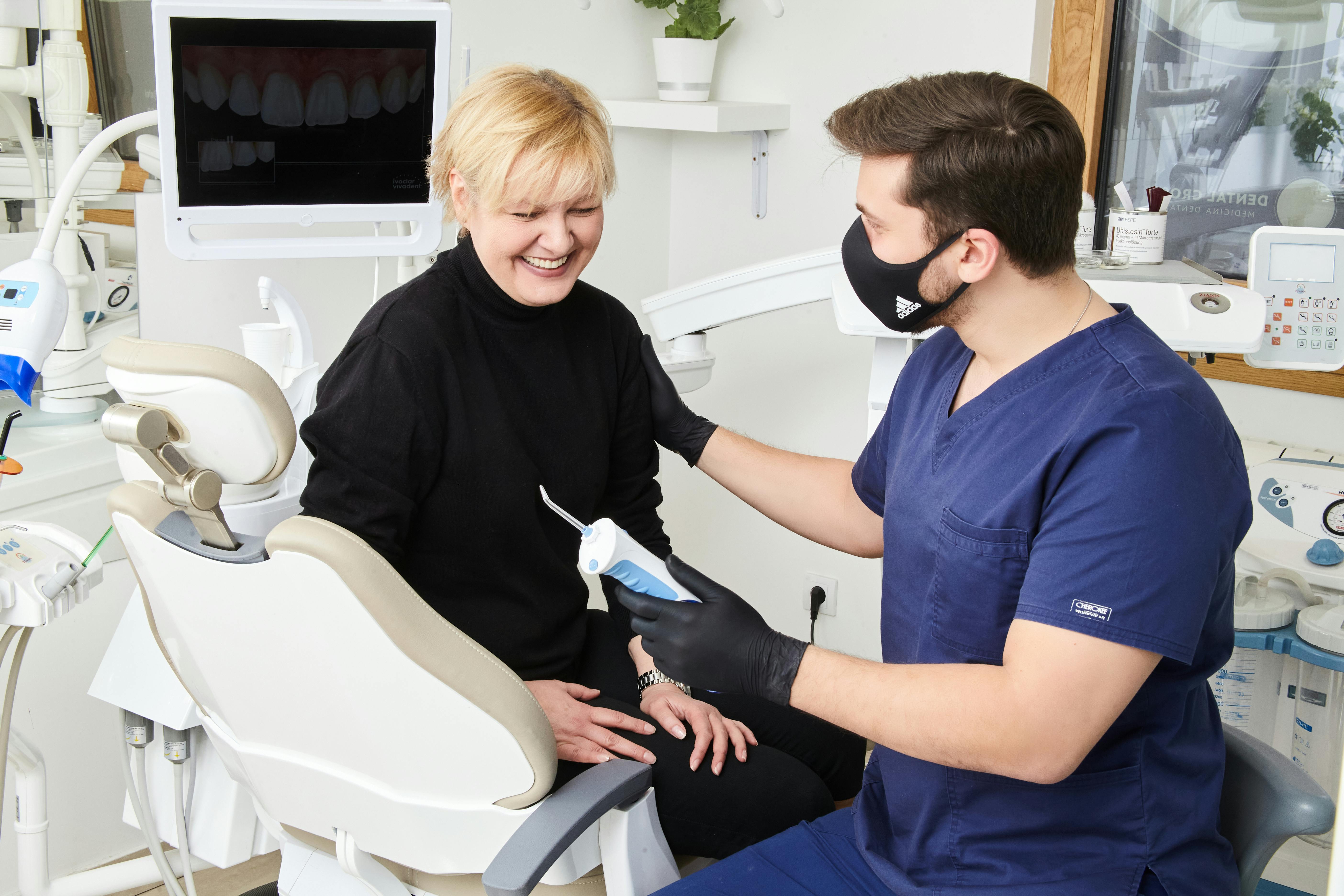
Every version of this journey starts the same way: a CBCT scan, not a visual exam or a sales pitch. The scan measures bone volume and density in three dimensions, showing exactly what a two-dimensional X-ray can’t. It’s the same standard we apply to every full-arch case, not a shortcut taken for this scenario specifically.
For a patient in their sixties or seventies, one of the first questions is usually whether age itself rules out implants. It doesn’t. We’ve written in detail about what actually disqualifies a candidate, and age on its own isn’t one of the factors that shows up in the research. What the scan is really checking for is bone volume, bone density, and any conditions that affect healing. If bone volume in the back of the jaw is too limited for standard placement, the scan is also what reveals whether angled implants, a small graft, or a zygomatic alternative is the better path. The scan itself works the same way across every implant case we plan, full-arch or single tooth.
Sometimes the scan changes the plan entirely. That’s the point of doing it before surgery day, not during it.
Surgery Day: Same-Day Provisional Placement
On surgery day, four implants go in, typically positioned with the back two angled to make the most of available bone. If each implant meets a minimum insertion torque, generally cited around 30 to 32 Ncm individually with a combined threshold near 120 Ncm across all four, a fixed provisional bridge can be delivered within hours of surgery. That torque number isn’t decided in the consultation room. It’s confirmed in the operating room, implant by implant, on the day itself.
That’s the actual mechanic behind “teeth in a day,” and it’s worth being precise about it: what goes in same-day is a provisional bridge, not the final, permanent prosthesis. The full mechanics of that distinction, along with what “same-day” does and doesn’t mean, are covered in more depth here. For a patient who’s spent years without a bridge that stays put, walking out of surgery with fixed teeth the same afternoon is still the part of the day that tends to stick with them, even though it’s the provisional, not the finish line.
Recovery: Weeks One Through Twelve

Recovery follows a fairly predictable pattern, regardless of who the patient is. Swelling tends to peak around day two or three, then eases over the following week. A soft-diet phase covers roughly the first several weeks, gradually widening as healing progresses. Underneath all of that, osseointegration, the biological process of bone fusing to the implant surface, keeps running quietly in the background for 3 to 4 months in the lower jaw, and 6 to 8 months in the upper jaw, before the final prosthesis can be safely fabricated and delivered.
One thing almost every patient in this position has to unlearn: standard floss doesn’t work on a fixed bridge. There are no natural gaps to thread it through anymore. The hygiene routine that actually works, an interdental brush plus a water irrigator alongside regular brushing, gets taught hands-on at the first follow-up, not just handed over as a printed sheet. It feels unfamiliar for the first week or two. Most patients get comfortable with it faster than they expect.
The Outcome: What Changes, Grounded in Real Data
What changes isn’t a guess or a testimonial, it’s what published research consistently shows for patients making this same transition. One study measured bite force roughly doubling after moving from a conventional denture to implant-supported support, 132N compared to 63N. A separate study using a validated oral health quality-of-life measure (OHIP-20) found a gap between the two groups well past the threshold generally considered clinically meaningful, not just statistically different on paper.
To be clear about what these numbers mean here: they describe what patients in this situation typically experience, based on published data, not a specific measurement taken from this composite character. The full bite-force and quality-of-life comparison, with sources, is covered in detail here, for anyone who wants the underlying studies rather than the narrative version.
[UNIQUE INSIGHT] Most “patient case study” content in this space does one of two things: invents specific, unverifiable outcome numbers for an anonymous patient, or publishes a real testimonial with no clinical grounding behind it. This piece is trying to do neither, staying honest about being composite while still tying every claim back to a real, cited study.
[PERSONAL EXPERIENCE] The specific details in this composite, the decade-plus of denture wear, the sore spots that keep recurring, the moment a patient first bites into something firm again, are drawn from patterns we see repeatedly in practice. No individual patient’s information was used to build this scenario.
[ORIGINAL DATA] We’re working toward publishing a genuine, consented patient case study once one is fully documented and available. Until then, this composite piece is a placeholder for that, built on real data rather than invented specifics.
Frequently Asked Questions
Is this a real patient case?
No. This is a composite, illustrative scenario built from common treatment patterns, not a specific documented patient. Genuine case studies require patient consent to publish, which this piece doesn’t claim to have.
How long does the whole journey actually take, start to finish?
From consultation to final prosthesis, the process typically spans several months, driven mainly by the osseointegration healing period, roughly 3 to 4 months for the lower jaw and 6 to 8 months for the upper jaw.
Will my own case look exactly like this?
Not necessarily. Candidacy, bone volume, and healing time vary by individual, which is why a CBCT-based consultation, not a generic timeline, determines your specific plan.
Does the practice have real patient testimonials?
We’re working toward publishing genuine, consented patient case studies as they become available. This composite piece exists to illustrate the process honestly in the meantime.
Conclusion
This composite journey reflects the real clinical data covered throughout this site’s full-arch implant guides: the same torque thresholds, the same healing windows, the same bite-force and quality-of-life research, applied to a realistic but invented scenario rather than an actual documented patient. The only way to know what your own journey looks like, timeline included, is a CBCT-based consultation. For the complete picture of All-on-4 and All-on-6, start from the beginning here.
Sources
- PMC, Immediate Loading Torque Thresholds for Full-Arch Implants: A Meta-Analysis, Journal of Clinical Periodontology, retrieved 2026-07-11, 2023
- PMC, Immediate Loading with Fixed Full-Arch Prostheses in the Maxilla: A Review, retrieved 2026-07-11
- Tallgren A., The Continuing Reduction of the Residual Alveolar Ridges in Complete Denture Wearers: A Mixed-Longitudinal Study, Journal of Prosthetic Dentistry, retrieved 2026-07-11, 1972
- PMC, Comparative Evaluation of Bite Force and Chewing Efficiency: Dentures vs. Implant-Supported Overdentures, Journal of Indian Prosthodontic Society, retrieved 2026-07-11, 2017
- PMC, Oral Health-Related Quality of Life: Conventional Dentures vs. Implant Overdentures, Medicina Oral Patología Oral y Cirugía Bucal, retrieved 2026-07-11, 2015