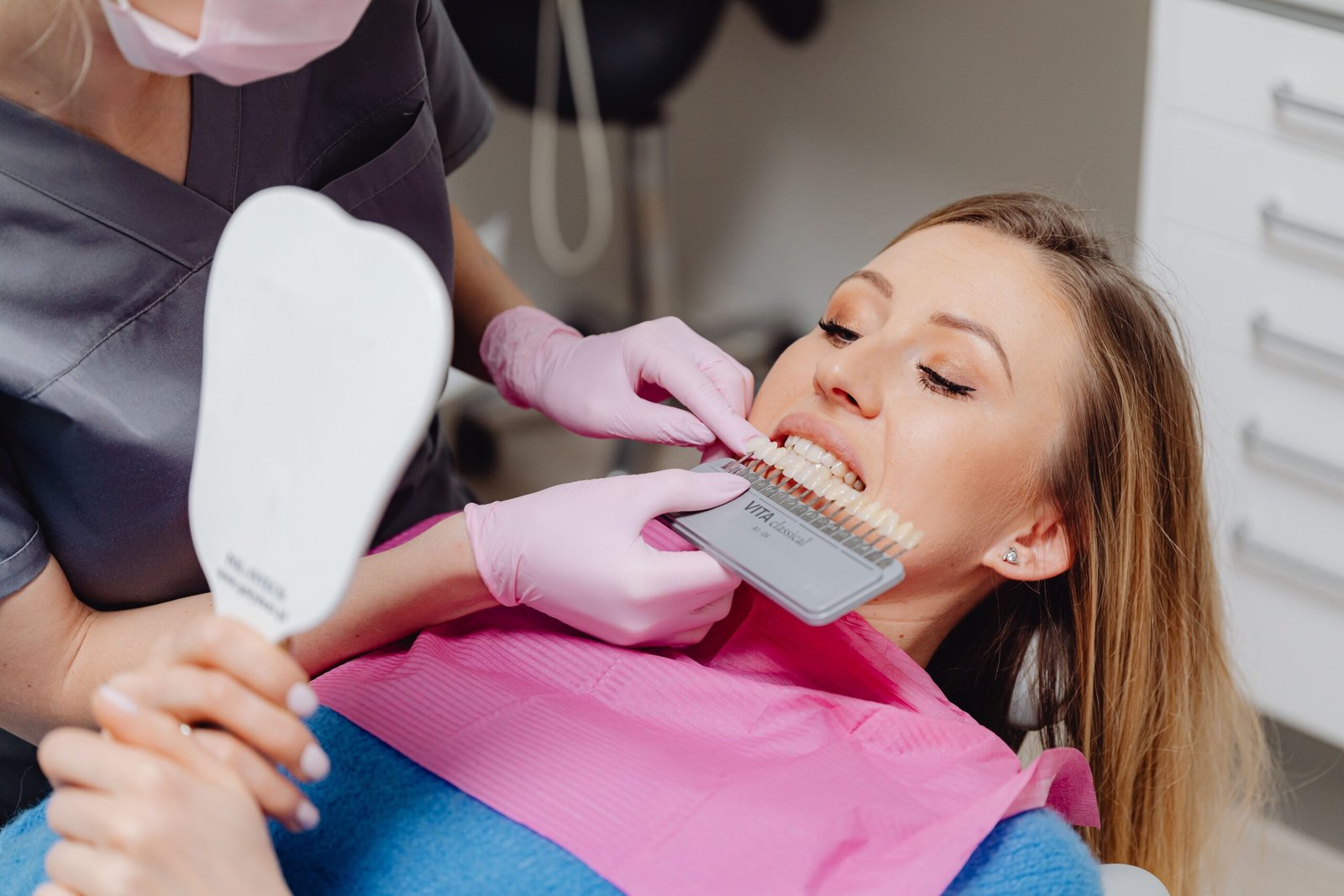
In 2025, a systematic review and meta-analysis of 23 studies found no significant difference in shade change between in-office and at-home bleaching (de Geus et al., Operative Dentistry, 2025). That single finding reframes most of the whitening choices people agonize over. The treatment you pick changes how fast you get there, what it costs, and how it feels, but it changes the average result far less than the marketing implies.
This guide pulls together what the evidence says about every route: in-office sessions, laser and light systems, dentist-made trays, over-the-counter strips, and whitening toothpaste. It covers how much whiter teeth get, how safe each route is, what whitening costs in Dubai, how long it lasts, and when whitening isn’t the right fix. Each section points to a deeper guide.
Key Takeaways Shade change was similar in-office and at-home across 23 studies, about 3 shade-guide units each in a 130-patient trial. Light activation did not improve final whitening in 10 systematic reviews. Results typically hold for about 1 to 2.5 years. Sensitivity is the most common side effect, and untreated decay and gum inflammation should be treated first.
What Are Your Whitening Options?
Five main routes exist, and they differ mostly in speed, cost, and supervision. In-office whitening is the fastest, take-home trays are dentist-made and slower, strips and toothpaste are sold over the counter, and the light or laser used with some in-office systems is an optional extra, not a separate treatment.
| Option | Typical Dubai range | What the evidence says | Deeper guide |
|---|---|---|---|
| In-office (Zoom-type) | AED 800-2,500 | About 3 shade units in a 130-patient trial, fastest route | Cost |
| In-office with laser or light | AED 1,500-3,500 | No improvement in final whitening across 10 systematic reviews | Laser vs. trays |
| Dentist-made trays | AED 300-800 | About 3.5 units in the same trial, durable results | Cost |
| Over-the-counter strips | AED 50-300 | Whiten short term, slightly behind supervised trays on measured color | Strips |
| Whitening toothpaste | Not priced in clinic guides | Reduces surface stain, about one or two shades at most | Toothpaste |
Dubai ranges come from aggregated clinic pricing guides in 2026 and are directional only, since no regulator publishes a price list (aggregated Dubai clinic pricing guides, 2026).
Which Route Fits Your Teeth and Your Priorities?
Start with a dental check, then choose by what matters most to you. The check comes first because untreated decay and active gum inflammation should be treated before bleaching, and because fillings, crowns, and veneers won’t change shade, which can leave a visible restoration darker than the teeth around it.
How Much Whiter Will Teeth Get?
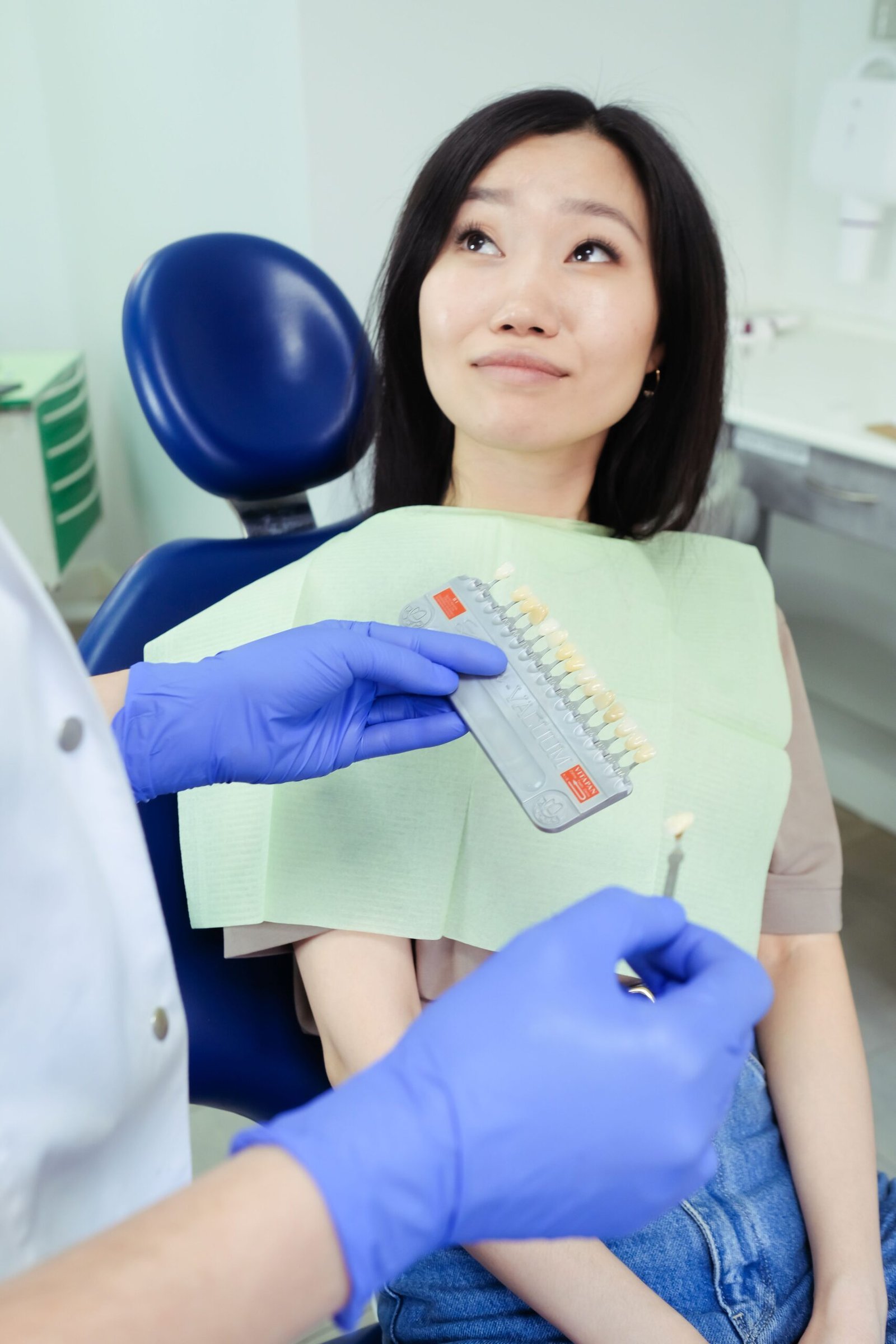
Around three shade-guide units on average for professional routes, with wide individual variation. In a 2021 randomized trial of 130 volunteers, in-office whitening with 35% hydrogen peroxide produced 3.0 units and dentist-made trays with 10% carbamide peroxide produced 3.5, with a standard deviation of about 2.2 units in both groups and no significant difference between them (Donassollo et al., Journal of Applied Oral Science, 2021).
That variation matters. Some patients gain one unit and some gain five, and no study has predicted which will happen to whom. Whitening toothpaste sits below that range, typically about one or two shades (Jamwal et al., F1000Research, 2022), and manufacturer claims of “8 units” of color change are footnoted lab measures, not trial results in patients, as the laser guide explains.
[CITATION CAPSULE] A 130-participant randomized trial found 35% in-office hydrogen peroxide and 10% at-home carbamide peroxide trays produced about 3 shade-guide units each, with no statistically significant difference and a standard deviation of about 2.2 units, so individual results vary more than the two methods differ (Donassollo et al., Journal of Applied Oral Science, 2021).
How Safe Is Teeth Whitening?
Generally safe for healthy teeth, with sensitivity as the main downside. In that trial, 37% of the in-office group reported sensitivity on day one against 15% of the tray group, and roughly half of both groups reported some in week one, falling to 5 to 8% a week after treatment ended (Donassollo et al., Journal of Applied Oral Science, 2021). A 2025 meta-analysis found the risk of sensitivity didn’t differ between routes, though intensity was lower at home, with low-certainty evidence (de Geus et al., Operative Dentistry, 2025).
On enamel, a 2026 meta-analysis found a small, outlier-sensitive drop in microhardness in laboratory studies only (ratio of means 0.89), and concluded peroxide bleaching is unlikely to cause clinically meaningful harm when protocols are followed (Marton et al., Journal of Dentistry, 2026). Pregnancy and breastfeeding are usually reasons to wait as a precaution, since many whitening products contain ingredients not well studied in those settings (MotherToBaby, 2023). The safety guide covers who should wait and how to reduce sensitivity.
Does Laser or Light Help?
Not for the whitening itself. A 2026 umbrella review of 10 systematic reviews covering 91 primary studies concluded that laser or light activation did not improve final whitening, and a 2012 meta-analysis found no difference with 25 to 35% peroxide while finding higher odds of sensitivity with light (Allende et al., Journal of Esthetic and Restorative Dentistry, 2026; He et al., Journal of Dentistry, 2012). A different technique, photobiomodulation, reduced post-bleaching sensitivity in five placebo-controlled trials without reducing whitening, with a moderate certainty rating. The premium for “laser” buys a system, not extra shades.
How Long Does Whitening Last?
About 1 to 2.5 years in most studies. A 2023 systematic review of 24 studies and 1,197 subjects found color after home bleaching remained stable across that range, with higher recurrence in severe intrinsic discoloration such as tetracycline staining (Fioresta et al., Clinical Oral Investigations, 2023). Pooled clinical trials found that restricting coffee, tea, or wine made no meaningful difference to bleaching effectiveness, though one randomized trial saw coffee rinses reduce lightening at three weeks. The durability guide goes through the follow-up data.
[UNIQUE INSIGHT] Put cost and durability together and whitening behaves like a recurring service, not a one-off. Over a 1 to 2.5 year window, an AED 800 to 2,500 in-office session works out to roughly AED 320 to 2,500 per year, against about AED 120 to 800 for trays, illustrative arithmetic on published ranges that shows the spread within one method is wider than the gap between methods.
How Strong Is the Evidence Behind These Answers?
Mixed, and it’s worth knowing which claims rest on firmer ground. Several conclusions rest on moderate-certainty evidence, while others, including the core question of whether in-office and at-home bleaching differ, rest on low-certainty evidence, and the enamel question has only been tested in the lab.
When Isn’t Whitening the Answer?
When the problem isn’t shade. Whitening can’t change the shape, spacing, or alignment of teeth, and it can’t change the color of veneers, crowns, or fillings. The veneers vs. whitening guide explains how to tell which one fixes what you’re seeing, and why whitening comes first when both are planned.
If a fixed date such as a wedding is driving the decision, the wedding smile timeline covers sequencing. For a worked example of whitening combined with veneers on exactly two teeth, see the composite smile makeover case study, and for keeping results up afterward, the maintenance routine.
[PERSONAL EXPERIENCE] The most productive whitening consultations start with the patient’s photo from a year ago and a mirror, not a menu of systems. Looking at what’s actually bothering them, the overall shade, one darker tooth, an old filling, usually settles the choice faster than any comparison chart.
[ORIGINAL DATA] We’re evaluating recording, in general terms, which whitening route patients in this practice choose after the evidence is explained, without publishing a figure until it’s properly documented across a larger patient base.
Frequently Asked Questions
What is the best teeth whitening option?
There isn’t one best option. A 2025 meta-analysis of 23 studies found no significant difference in shade change between in-office and at-home bleaching, so the choice depends on speed, price, and how your teeth feel afterward.
How much does teeth whitening cost in Dubai?
Clinic guides in 2026 quote roughly AED 800 to 2,500 for in-office sessions, AED 1,500 to 3,500 for premium laser systems, AED 300 to 800 for dentist-made trays, and AED 50 to 300 for over-the-counter products. Prices vary between clinics.
Is teeth whitening safe?
For healthy teeth and gums, generally yes. Sensitivity is the most common side effect, reported by roughly half of participants in one trial in week one, and it mostly fades within a week of finishing. Untreated decay and gum inflammation should be treated first.
Does laser whitening work better?
Not on current evidence. A 2026 umbrella review of 10 systematic reviews found laser or light activation did not improve final whitening, and a 2012 meta-analysis found higher odds of sensitivity with light.
How long does teeth whitening last?
About 1 to 2.5 years in most studies, with higher recurrence in severe intrinsic stain such as tetracycline. A 2-year randomized trial found no significant rebound after either in-office or at-home bleaching.
Do whitening strips and toothpaste work?
Strips whiten short term, slightly behind supervised trays on measured color, and toothpaste reduces surface stain by about one or two shades at most. Neither changes the color of veneers or fillings.
Conclusion
Teeth whitening is a well-studied treatment with a predictable pattern: a modest average gain, a short-lived sensitivity risk, and results that last roughly one to two and a half years. The route changes speed, cost, and comfort more than it changes the shade.
A dental check first, then a choice based on your priorities, is the sequence that holds up in the evidence. Use the guides below for the detail behind each step.
Continue Learning
Cost and Choosing a Route:
- Teeth Whitening Cost in Dubai: In-Office vs. At-Home Pricing
- Laser vs. Zoom vs. Tray Whitening: Does the Light Actually Help?
- Do Teeth Whitening Strips Work? Trials vs. Dentist-Made Trays
- Does Whitening Toothpaste Work? What It Can and Can’t Change
Safety and Results:
- Is Teeth Whitening Safe? Sensitivity, Enamel, and Who Should Wait
- How Long Does Teeth Whitening Last? What Actually Keeps It Bright
Beyond Whitening:
- Veneers vs. Teeth Whitening: Which Actually Fixes What You’re Seeing
- Veneers in Dubai: The Complete Patient Guide
Sources
- de Geus JL, Martins A, Reis A, et al., At-home vs In-office Bleaching: An Updated Systematic Review and Meta-analysis, Operative Dentistry 2025;50(4):E47-E69, retrieved 2026-10-24 (Tier 1, 23 studies, certainty low)
- Donassollo SH, Donassollo TA, Coser S, Wilde S, Uehara JLS, Chisini LA, Correa MB, Cenci MS, Demarco FF, Triple-blinded randomized clinical trial comparing efficacy and tooth sensitivity of in-office and at-home bleaching techniques, Journal of Applied Oral Science 2021;29:e20200794, retrieved 2026-10-24 (Tier 1, randomized controlled trial, n=130)
- Allende JB, Campos-Bijit V, Morales-Gomez C, Diaz L, Gomez VC, Fernandez E, Do Laser and Light Activation Improve In-Office Dental Bleaching Outcomes? An Umbrella Review, Journal of Esthetic and Restorative Dentistry 2026;38(9):1665-1690, retrieved 2026-10-24 (Tier 1, umbrella review of 10 systematic reviews, 91 primary studies)
- He LB, Shao MY, Tan K, Xu X, Li JY, The effects of light on bleaching and tooth sensitivity during in-office vital bleaching: a systematic review and meta-analysis, Journal of Dentistry 2012;40(8):644-653, retrieved 2026-10-24 (Tier 1, 11 studies pooled)
- Marton P, Antal M, Kiss-Dala S, et al., Enamel damage from tooth-whitening: a systematic review and meta-analysis, Journal of Dentistry 2026;172, retrieved 2026-10-24 (Tier 1, 9 studies pooled, in vitro only)
- Fioresta R, Melo M, Forner L, Sanz JL, Prognosis in home dental bleaching: a systematic review, Clinical Oral Investigations 2023;27(7):3347-3361, retrieved 2026-10-24 (Tier 1, 24 studies, 1,197 subjects)
- Munchow EA, Tavora WS, de Oliveira HT, Machado LS, White diet is not necessary during dental bleaching treatment: A systematic review and network meta-analysis of clinical studies, Journal of Dentistry 2025;153:105459, retrieved 2026-10-24 (Tier 1, 7 studies, GRADE moderate, abstract-level data)
- da Rosa G, Maran BM, Schmitt VL, Loguercio AD, Reis A, Naufel FS, Effectiveness of Whitening Strips Use Compared With Supervised Dental Bleaching: A Systematic Review and Meta-analysis, Operative Dentistry 2020;45(6):E289-E307, retrieved 2026-10-24 (Tier 1, 20 randomized trials, abstract-level data)
- Eachempati P, Kumbargere Nagraj S, Kiran Kumar Krishanappa S, Gupta P, Yaylali IE, Home-based chemically-induced whitening (bleaching) of teeth in adults, Cochrane Database of Systematic Reviews 2018;12:CD006202, retrieved 2026-10-24 (Tier 1, 71 trials, certainty low to very low)
- Jamwal N, Rao A, Shenoy R, Pai M, Ks A, Br A, Effect of whitening toothpaste on surface roughness and microhardness of human teeth: a systematic review and meta-analysis, F1000Research 2022;11:22, retrieved 2026-10-24 (Tier 1, 7 in vitro studies)
- MotherToBaby, Whitening Teeth during Pregnancy or Breastfeeding? Let’s Bite into the Subject!, published 2023-11-14, retrieved 2026-10-24 (Tier 3, no peer-reviewed safety trials located)
- Aggregated Dubai teeth whitening pricing guides, cross-referenced from this site’s Teeth Whitening Cost in Dubai guide, retrieved 2026-10-24 (Tier 4, clinic and directory marketing pages, directional only)
- Cross-referenced findings from this site’s whitening spokes (cost, safety, laser vs. tray, longevity, strips, toothpaste), retrieved 2026-10-24